Kavrepalanchok district in figures
· 13 min read
– Keshav Thapa
Introduction
Geography
Kavrepalanchok is one of the districts in the mid-eastern hills of Nepal. Covering 1,396 square kilometres, it lies between 85°24' and 85°49' east longitude and 27°20' and 27°45' north latitude. Its average temperature is 18°C. Ranging from 280 metres above sea level (Kokhajor Khola) to 3,108 metres (Bethanchok Narayan Danda), the district falls in Bagmati Province and, under the latest administrative division, has thirteen local levels.
Its varied terrain brings some variety in climate, but overall the district is temperate. It borders Ramechhap and Dolakha to the east, Lalitpur, Bhaktapur and Kathmandu to the west, Sindhupalchok to the north, and Sindhuli and Makwanpur to the south. Sanga, the gateway to the district, lies 21 km east of the federal capital, Kathmandu, and the district headquarters, Dhulikhel, is 30 km away. The district has 492 rivers, streams and waterfalls, large and small; the main ones are the Indrawati, Bagmati and Sunkoshi rivers and the Roshi, Kokhajor and Khani Khola. It has no large lakes, but its ponds include Tarakhase Pokhari (Shikhar Ambote), Narayan Pokhari (Timal), Deupokhari (Chaunri Dumkharka) and Mahadev Pokhari (Nagarkot).
Political and administrative divisions
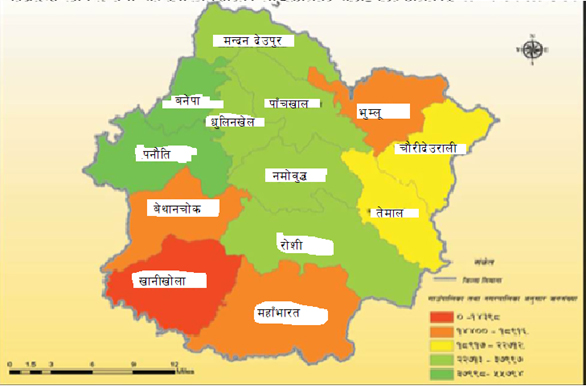
Under the earlier administrative structure the district was first divided into 99 Village Development Committees (VDCs); until 27 Falgun 2073 B.S. it had five municipalities and 75 VDCs. Since the promulgation of the Constitution of the Federal Democratic Republic of Nepal (2072 B.S.), it has been divided into 13 local levels (7 rural municipalities and 6 municipalities) with 87 wards in total. It has two constituencies for the House of Representatives and four for the Provincial Assembly.
The district has played an active part in every major political change in the country. Krishna Prasad Khatiwada of Anekot, Kavre, the first graduate from Kavrepalanchok, was involved in the library movement against Rana rule that began in 1988 B.S. From the early 2030s B.S., left-wing politics spread widely here. Today both left and democratic forces have a strong presence, although, as across the country, new political forces also appear likely to gain ground.
Population
The 2001 census put the population of Kavrepalanchok at 385,672. By 2011 it was 381,937, and the 2021 census recorded only 364,039. Men make up 49.1 percent of the population and women 50.9 percent. Between 2011 and 2021 the population growth rate was negative, at −0.46 percent. Apart from Banepa Municipality (1.5 percent) and Panauti Municipality (0.77 percent), all eleven other local levels had negative growth. Chaunri Deurali Rural Municipality (−3.8 percent), Namobuddha Municipality (−1.3 percent), Panchkhal Municipality (−1.1 percent), Khanikhola Rural Municipality (−1.6 percent), Roshi Rural Municipality (−1.8 percent) and Mahabharat Rural Municipality (−1.2 percent) shrank by more than one percent, and the rest by less than one percent. It deserves serious thought that, just as development reaches the villages through local government, the very people who should enjoy its benefits are leaving their homes one after another, whether for opportunity, a more comfortable life or other reasons.
The district is home to some 58 castes and ethnic groups: Tamang (33.77 percent), Brahmin (20.15 percent), Chhetri (13.57 percent), Newar (13.41 percent), Magar (3.99 percent) and others. Kavrepalanchok must not forget that it embraces unity in diversity and diversity in unity. With its population in decline, the district's average density is 261 people per square kilometre.
Economic activity
Although the economically active population is taken to be those aged 15 to 64, the census classified by national occupation the work done by 223,356 people aged 10 or over in the district, 61.35 percent of the total population. Of the labour force in economic work, 65.02 percent are in agriculture, forestry and fishing; 9.30 percent in wholesale and retail trade and vehicle and motorcycle repair; 4.81 percent in construction; 3.18 percent in manufacturing; 2.94 percent in education; 3.0 percent in public administration and security; 1.52 percent in finance and insurance; and 1.65 percent in accommodation and food services, with negligible shares in other fields. Industry, trade and salaried jobs appear to be secondary occupations rather than a full livelihood. The Newars of the towns and bazaars are engaged in trade, and livestock farming supplements agriculture. The Danuwar, Majhi, Pode and Pahari communities living along the rivers once fished, but rising river pollution, falling water levels and stone quarrying have brought this almost to a halt.
For now, the first priority for Kavre's prosperity must be agriculture and livestock. Those responsible should give high priority to modernising, commercialising, diversifying and mechanising agriculture, and to making farming a dignified and respected profession. Religious, recreational and eco-tourism can also be called emerging sectors for Kavre. Stakeholders would do well to draw Kavrelis into other promising areas of employment through proper education, training and incentives. Making the best possible use of the economically active population, before it becomes economically inactive, should be a top priority for the district.
Literacy
Kavrepalanchok has a literacy rate of 75.68 percent: 84.14 percent for men and 67.60 percent for women. Of the literate population, 48.5 percent have a bachelor's degree or equivalent, and 1.61 percent a master's degree or equivalent or higher. Yet, for lack of employment-oriented education and training, this population does not seem able to benefit fully from its education. Academic certificates are becoming an obstacle to employment rather than a means to it. In a district close to the Kathmandu Valley that is becoming a centre for many educational institutions, including a well-known university, it cannot be considered good news that 24 percent of Kavrelis are still illiterate.
By 2080 B.S. the district had 490 early childhood development centres, 369 community basic schools, 149 community secondary schools, 26 institutional basic schools, 76 institutional secondary schools, 16 community campuses and 3 private campuses.
Figures show 52,854 students studying up to grade 12 in community schools and 33,613 in institutional schools. Net enrolment is above 90 percent and the dropout rate is 2 percent, while the teacher–student ratio is 1:12 for grades 1 to 5, 1:3 for grades 6 to 8 and 1:6 for grades 9 and 10. These figures point to the need for deep reflection on education in Kavrepalanchok.
Religion, culture and language
By language, Nepali speakers come first in the district and Tamang speakers second. Among religions, Hindus are the largest group, followed by Buddhists. With the long presence of a mission hospital and a growing trend of conversion in recent years, the number of Christians is also rising. Everyone has the right to follow the religion of their faith, but we should be wary of the fact that conversions encouraged from behind the scenes could cause serious problems in future.
The people of Kavre celebrate every festival of the year, from Dashain and Tihar to Saune Sankranti, Teej, Rishi Tarpani, Janai Purnima and others, joyfully and as their means allow. The Newars have their guthis and celebrate festivals such as Sithi. Tamangs who follow the lamas, or Buddhism, celebrate festivals such as Lhosar around the gumbas in their villages. The festivals people celebrate have taken on a social role that gives each community its identity.
Described as a district rich in religious, cultural and historical features, Kavrepalanchok is one of the foremost districts in art and culture. It is said that a nine-storey house built in China by artisans from Banepa, on the model of Banepa's nine-storey palace, still stands. On this basis some hold that Araniko, the unrivalled figure of fine art, belonged to the royal family of Balyo (Banepa), while others say the artist was a Pahari from Khopasi. This calls for thorough research. The monasteries, temples, gumbas and palaces of Banepa, Panauti, Dhulikhel, Palanchok and Namobuddha are fine examples of traditional art and craftsmanship. As the process of listing some of these on the World Heritage List has already begun, we must act responsibly to see it through and to preserve the heritage our ancestors left us.
Literature
Many literary talents from Kavre have enriched Nepali literature with their works, and some are still devoted to it; this will surely continue. The seed of literature that sprouted in Kavre's soil in the Lichchhavi and Malla periods has been carried on by writers including Basanta Sharma (the earliest Kavreli poet so far found), Shyamdilmai Paudel, Hari Prasad Nepal, Nar Bahadur Bharati (a devotee of music as well as literature, and a scholar of Ayurveda and alchemy), Gangadatta Thapaliya, Guru Prasad Mainali (a towering pioneer of the Nepali short story), Rajdas Bade, Premnath Satyal, Ashakaji Sewak, Krishna Prasad Parajuli (a gifted writer in Nepali language, literature, linguistics and folk literature), Janak Humagai, Kiran Kharel (a celebrated and popular Nepali lyricist), Shyamsundar Saiju, Banshi Shrestha, Ramesh Khakurel, Yadav Kharel, Shiv Prasad Satyal Peeth, Gopalraj Mainali, Kanhaiya Nasnani, Kedarnath Pradhan (founding campus chief of Kavre Multiple Campus and a tireless scholar of history, culture and literature), Gyankaji Manandhar, Mohan Duwal, Hari Adhikari, Dhruba Sapkota, Bharati Kharel, Haribansha Acharya, Harimanjushree (born in Bhojpur but for decades devoted to writing and editing on Kavre's soil), Geeta Tripathi, Phulman Ban, Prof. Dr. Suman Tamrakar, Surya Lakoju and Bijay Sapkota. For lack of space only some names are mentioned here; many other Kavreli writers are steadily devoted to literature for its own sake. The point of this discussion is to remind the local governments of Kavre, since the district is a mine of talent in education, literature, art, culture and administration, that it would be good to give priority to honouring the nationally known figures born in their areas and to holding literary fairs and gatherings in the district or their municipalities from time to time.
Employment
According to the latest census, of the economically active population 54.44 percent are employed for six months or more a year, 17.11 percent for less than six months, and 28.45 percent of Kavrelis are wholly unemployed. Squeezed by under- and unemployment, more than 30 percent of the people of Kavrepalanchok are forced to live below the absolute poverty line. Unemployment is therefore another alarming problem for the district. Unless timely, planned steps are taken to tackle it, the consequences of hunger could be dire.
Migration and foreign employment
Available figures show that, of Kavrepalanchok's 91,428 households, 26,583 (29.08 percent) have members who have moved within the country and 15,096 (16.52 percent) members who have moved abroad. Of the total population of 364,039, 95,624 have moved within the country and 19,854 have gone abroad for various purposes. People from municipalities are more likely to go abroad than those from rural municipalities: Banepa (3,528), Panauti (2,744), Panchkhal (1,886) and Dhulikhel (1,863) lead. That people are leaving for abroad in greater numbers from the municipalities, which offer the most scope for education, employment and a comfortable life, deserves serious study. Meanwhile 107,016 people have moved into Kavrepalanchok through marriage or in search of work, drawn mostly to municipalities such as Banepa (31,868), Panauti (18,196), Dhulikhel (13,579) and Panchkhal (10,461).
Main problems
Kavre's 13 local levels and their 87 wards each have particular problems of their own, but overall the main problems of Kavrepalanchok can be said to be these:
- The growing departure abroad of young people, who are economically active, the drivers of change and Nepal's future potential
- The lack of an effective mechanism to keep harmony, coordination and unity among religious, cultural and ethnic diversity
- The failure to conserve Kavre's religious, cultural and historical heritage and to promote religious tourism
- Arable land being turned to unproductive uses day by day
- A negative population growth rate
- The failure to establish Kavre as a major centre of education, literature and culture despite ample potential and a proud history
- Abnormally rising rates of domestic violence, divorce, family breakdown and suicide
- Public land and property not being protected
- Agriculture, livestock, dairy and a growing number of cooperatives are Kavre's strengths, yet their growth, quality and regulation have not progressed as expected, and farming has not been made scientific or commercial
- A lack of road transport and other physical infrastructure in several local levels; two local-level centres and many ward centres still have no paved road
- A lack of enough clean drinking water in the dry areas (Koshipari, Temal, Palanchok, Dapcha) and even in the towns of Banepa, Panauti and Dhulikhel
- No quality health care or higher education at affordable cost
- No culture among political parties of healthy, constructive competition combined with coordination and cooperation for the good of the district and its people
- Available natural resources (stone, gravel, sand, herbs and so on) not being used to best effect, and a handful of profiteers holding sway over them
- A lack of integrity and good governance among some party leaders, cadres and public office holders
- The failure to organise, enable and empower women, who make up more than half the population, and to involve them meaningfully in economic, social, political and other policymaking
- Poorly run mines, and bulldozer-led development carried out on impulse without technical advice, consultation or supervision, harming the environmental balance
- No reasoned settlement of the "mines or water" dispute
- About 30 percent of the population still below the absolute poverty line, and a quarter still illiterate
- Those responsible not paying enough attention to the fact that Kavrelis themselves are both the means and the end of the district's prosperity
If the root causes of these problems are identified, and work moves forward with short-, medium- and long-term plans and vision, driven by the local levels with support from the provincial and federal governments, we can be confident that the problems will gradually be solved and that Kavrepalanchok will become a place where people choose to live.
The district's potential
Given its location and what it has achieved over time, the district's potential and strengths can be listed as follows:
- Very close to the federal capital, Kathmandu
- Located near the middle of Bagmati Province, within easy reach of its 13 districts
- Rich potential in minerals (copper, iron, mica, sulphur, graphite, lead and others)
- Unity amid diversity
- An attractive destination for religious, cultural, recreational, eco- and educational tourism
- Fertile ground for literature, art and culture
- Flat, fertile land
- A proud history of reaching the heights of civilisation and prosperity in the Lichchhavi and Malla periods
- Birthplace and place of final passing of Prince Mahasattva (Namobuddha)
- Developing as a well-known centre of education
- A district of towns full of jatras, fairs, festivals and temples
- Outstanding in arts, crafts and craftsmanship
- Famous for lapsi, Buddha-chitta beads, potatoes, oranges and other fruit
- Home of the Panauti Hydropower Project (2024 B.S.), Nepal's third oldest
- The potential to become an education hub, with prestigious academic institutions such as Kathmandu University
- Part of the Mahabharat range, rich in natural resources and biological and environmental diversity
- A large economically active population
Conclusion
Like the Kathmandu Valley, Kavrepalanchok carries a rich religious, cultural and historical heritage. It is the holy land where Prince Mahasattva (Namobuddha) was born and passed away, some 3,500 to 3,600 years before Gautama Buddha was born at Lumbini in Kapilvastu. The Makar Mela held for a month in Magh every twelve years at the Panauti Triveni Dham (also known as Uttar Prayag and Shachi Tirtha) and similar events make Kavre known as a religiously distinguished district. On this basis the Bagmati Province government should declare these places special religious and cultural areas, protect, develop and promote them, and work to establish Kavrepalanchok as the province's destination for religious, cultural, eco- and educational tourism.
The local levels of Kavrepalanchok's Dandapari and Koshipari areas still lack easy transport access, and stakeholders need to turn their attention there quickly. Road transport should be linked not only to travel but to production, and developed as an important part of economic growth. We can be confident that the dream of a prosperous, stable Kavrepalanchok, and a dignified place to live, can come true if we: finish the overdue repair of the Dhulikhel–Panchkhal section of the Araniko Highway; bring the security printing press set up in Kavre into operation as soon as possible; run the sericulture farm at Khopasi at full capacity with modern methods; free Banepa from its yearly flooding by adopting the measures that highly qualified experts recommend; make the district, already a leader in cash crops (potatoes, vegetables, oranges and other fruit) as well as food grains, livestock and dairy, a centre of attractive employment by modernising, commercialising and marketing these into respected professions; adopt a zero-tolerance policy on good governance; and carry development forward fairly, prioritising needs as the facts and figures show.
References
- District Profile, 2080, Kavrepalanchok
- Kavre Pragya
- Purva Ek Number
- Various issues of Kavreli Gunjan
- Various issues of the weeklies Cheshta and Kavre Times
- Publications of political parties active in Kavrepalanchok