
Namobuddha, playground of the Buddha's former life: Namobuddha–Tagmo Lhujin across the world
· 14 min read
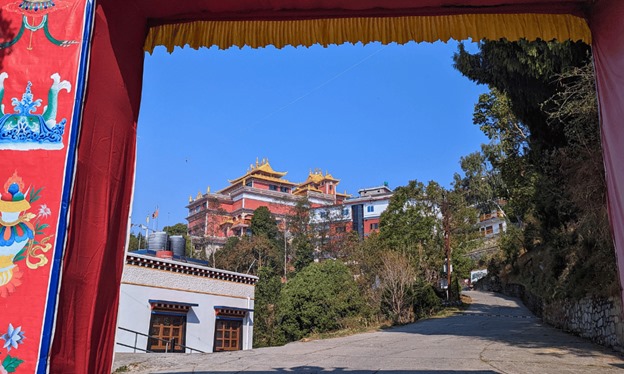
About 40 kilometres east of Kathmandu, the capital of Nepal, by way of Koteshwar, Bhaktapur and Sangachok, then from Banepa to Dhulikhel and on from Kavrebhanjyang along the road to Phulbari and Dapcha, lies the world-famous Buddhist pilgrimage site of Namobuddha, or Tagmo Lhujin. It is a drive of about 1 hour 40 minutes from Kathmandu by car. It can also be reached from Banepa by way of Panauti, the ancient Panchal country, and on past Sankhu and the Sankheshwari temple, with a short climb at the end.
The site stands at about 1,700 metres above sea level, in the midst of the Kushma forest, a dense and beautiful forest of evergreen rhododendron, chestnut, walnut, amala and other trees. About 200 metres uphill from the Namobuddha stupa is Gandhamadan hill, with a fourth-century stone sculpture of Prince Mahasattva (Nyingtob Chhenpo) feeding the flesh of his own body to a tigress. It is believed that this is where Mahasattva gave his body to the tigress and her cubs. From the forested summit of Gandhamadan there are sweeping views of the Himalayan ranges to the north and east, including Gauri Shankar and Chomolungma (Everest). Its whole southern slope is taken up by the Buddhist study centre Thrangu Tashi Yangtse Monastery, with an international-standard meditation centre.
In the name, tagmo means tigress, lhu body and jin whole: the Jataka tale of giving one's whole body to a tigress. The whole forested mountain of Namobuddha has been known by many names, among them Gandhamadan Parvat, Hiranya Giri, Suvarna Parvat, Gandhakut Parvat, Yogakul Parvat and Kushmavan Parvat (Manandhar, 2053).
There is a car park near the Namobuddha stupa. Fifteen to twenty metres from it stands the ancient stupa or chaitya (chhorten), believed to have been built over a golden urn holding the relics of Mahasattva. In front of the chaitya is a temple with an image of Namobuddha, and before that a shrine for lighting butter lamps. Prayer wheels line the outer circuit of the chaitya, and places for lamps have been made along the inner circuit. On the west side of the chaitya, the golden urn of relics can be glimpsed through a small niche. On the corner where the path climbs from the stupa towards the ridge, one can see a distinct local Buddhist custom: Newar Buddhists hang framed mirrors and photographs of the dead there, so that the departed may gain merit.
Newar Buddhists live in the towns of Panauti, Sankhu and elsewhere, while Tamang Buddhists live in dense settlements around Tagmo Lhujin, that is, Namobuddha. The lama of Namobuddha Gonpa explained the name: in classical Tamang, tag means tiger, mo female, lhu body and jin whole, so that "Tagmo Lhujin" means the whole body offered or given to a tigress. In the Prakrit of the Buddha's time it is called "Namo Buddha", and in the local Newar language "Namura", a shortened form of "Namo Buddha". According to Buddhist literature, Shakyamuni Buddha himself came here on pilgrimage and bowed in homage; because even the Buddha said namo, "I bow", the place came to be called Namobuddha (Manandhar, 2053).
In the middle of the dense forest stands the Namobuddha chaitya (chhorten), the Bhuvaneshwar chaitya of the seven jewels, built over a golden urn holding the relics of the great giver Mahasattva (Semchhen Chhenpo in Tamang). Since ancient times its glory has spread not only in Nepal but throughout the Buddhist world. In the Himalayan communities of Nepal, and in the northern (Mahayana) Buddhist tradition, a chaitya or stupa is called a chhorten in the classical Buddhist language, and throughout that world the Buddha's teaching stories of the perfection of giving, full of great compassion, are loved everywhere.
The story in the Jatakamala
The core of the story of Namobuddha, as told in the Mahayana (northern Buddhist) Jatakamala, is this. It is set at the end of the Dvapara Yuga and the start of the Kali Yuga, in the age of the Dharma after the passing of Kashyapa Buddha (Manandhar, 2053: 14). Gyalbo Singtak Chhenpo (King Maharatha) and Gyalmo Padma Mahamaya Devi (Queen Satyavati) of Panchal had three sons: the eldest, Dachhenpo (Mahapranava), the second, Lachhenpo (Mahadeva), and the youngest, Semchhen Chhenpo (Mahasattva). According to Buddhist literature, the youngest, Mahasattva, had through many ages, the Satya, Dvapara and Treta, lived 32 lives as a greatly compassionate bodhisattva, saving the beings of the world. Because of this great store of compassionate merit, the episode of Mahasattva and the tigress with her cubs became famous as a Jataka tale.
One day the three princes went walking in the forest. There they saw a tigress who had just given birth, so weak with hunger that she was ready to eat her own five cubs. Great compassion rose in Mahasattva's heart. On the way back to the palace he made an excuse to his brothers, telling them to walk on ahead, and went back to where he had seen the tigress and her cubs. He gave the dying tigress and her five cubs the blood and flesh of his whole body. According to the Jataka verses, immediately after this gift Semchhen Chhenpo (Mahasattva) was reborn as a bodhisattva in the Tushita heaven. The bodhisattva Mahasattva was later born again in human form in the sacred garden of Lumbini, as Prince Siddhartha Gautama, son of King Shuddhodana of Kapilvastu. Renouncing the kingdom and a life of attachment, aversion, delusion and luxury, Prince Siddhartha attained perfect enlightenment and became Siddhartha Gautama, the Buddha.
The Mahayana Jatakamala of the northern tradition records that Shakyamuni Buddha himself came to this place and told this story. On the full moon of Ashadh, when the Buddha met his mother Mahamaya Devi, who was keeping the eighth-day observance in the Tushita heaven, it was settled there that he would descend to the land of Panchal on the full moon of Kartik, Kojagrat Purnima, and that they would speak on that day. So the Buddha and his disciples reached Hiranya Giri, that is, Gandhamadan hill, in the land of Panchal, a day before Kojagrat Purnima. Seated in the diamond posture on that hill, through the power of his meditation and the divine eye of his merit, the Buddha saw the seven-jewelled Bhuvaneshwar chaitya holding the golden urn of Mahasattva's relics, which had fallen into ruin and sunk into the earth, and he bowed to it in homage. There he taught Ananda, Shariputra and the community of monks about the chaitya. The ruined chaitya was later rebuilt by the father of the monk Shariputra (Manandhar, 2053: 4–15).
Because the Buddha taught here about the compassionate deed of his own former life, and came in person to the Kushma forest of Hiranya Giri, or Gandhamadan, to pay homage to the seven-jewelled Bhuvaneshwar chaitya holding Mahasattva's relics, this chaitya has been known ever since as the "Namobuddha chaitya". In the northern (Mahayana) Buddhist world, from the Buddha's own Jataka "Tagmo Lhujinkyi Do", the place has been known for ages as Tagmo Lhujin, a pilgrimage site of unique and compassionate merit, and the teaching of "the hungry tigress", in Sanskrit the Vyaghri Jataka, is known throughout the Buddhist world.
Namobuddha around the world
The story of the bodhisattva Semchhen Chhenpo (Mahasattva), who gave his whole body to save the lives of a starving tigress and her five cubs, is a celebrated example of great compassion across the Buddhist world. In its many versions, told in many places, this gift of the body to the hungry tigress and her cubs is loved as a model of the perfection of giving. This is why the Buddha himself, Buddhist monks, great adepts, Buddhist scholars and lay followers from all over the world have come to Namobuddha on pilgrimage. The Jataka of the hungry tigress and her cubs is found in many countries, as follows.
Nepal
Buddhist communities across Nepal come to Namobuddha on pilgrimage every year, at various times, for festivals, worship and prayer. Among Newar Buddhists the site has a special place as Namobuddha or Namura. The Himalayan Buddhist communities of Nepal's northern tradition, the Tamang, Hyolmo, Sherpa, Lhomi, Singsawa, Thudam, Bhote, Manange, Humli, Mugali and others, visit it as "Tagmo Lhujin Ne". In Mahayana literature, Namobuddha is discussed in the "Tagmo Lhujin Do", the sutra of the gift of life to the tigress (Gurung Lama, 2068: 39), and in "The History of the Three Great Chaityas of Nepal" (Lama and Sherpa, 2066). The tradition is also known in Tibet, India, Bhutan and other Buddhist countries neighbouring Nepal.
China
In the ancient Buddhist cave monasteries of Dunhuang, the thousand Buddha caves of Gansu province in north-west China, a mural in Cave 254 shows Prince Mahasattva giving his body to the hungry tigress and her cubs, and the story also appears in the Buddhist texts found there. The documentary shown in the 360-degree theatre of the Dunhuang Academy still tells the story of the great giver Mahasattva as painted in the cave. Among the hundreds of cave shrines at this historic, archaeological, religious and cultural centre of Gansu, Cave 254 depicts the Jataka of the bodhisattva Mahasattva's gift to the starving tigress and her cubs in an original Chinese style. For lack of knowledge that Namobuddha is in Nepal, the place of the Vyaghri Jataka shown at Dunhuang has been given elsewhere, although it is in fact in Kavre district of the Federal Republic of Nepal. Even so, the story of Mahasattva's gift of his body to the hungry tigress and her cubs is clearly popular in China too.
Sri Lanka
The story of the "Hungry Tigress", in which the bodhisattva Prince Mahasattva gave his whole body to the tigress and her cubs, does not appear in the Tripitaka, the authoritative canon of southern (Theravada) Buddhism. But the Japanese researcher Matsumura (2014) records that the story is very popular in the Theravada world. Matsumura notes that Chinese monks who travelled to Sri Lanka on pilgrimage in ancient times knew of it, and that this compassionate Jataka of the bodhisattva's gift of his body to the tigress and cubs was current in Sri Lanka by the fifth century. A Chinese monk and pilgrim (320–420 AD) reported that during his stay (410–412 AD), the "Hungry Tigress" Jataka was among the many Jatakas the king had recited at the festival of the Buddha's tooth relic. In the northern Buddhist world, the Jataka of the gift to the hungry tigress is found in many versions. One particular text of the tigress Jataka was translated into Chinese by the Chinese monk Fasheng (406–479); this version is still unknown to most modern scholars. Matsumura also notes that twenty years after the Chinese monks Faxian and Fasheng went on pilgrimage to India and Sri Lanka, on their way back by almost the same route they reached a place near Taxila where the bodhisattva was said to have given his body to the tigress. If that was indeed the place where Mahasattva gave up his body to the starving tigress, they must also have reached Namobuddha. This needs study.
Tibet (China) and Bhutan
In Tibet and Bhutan, a popular collection of the Buddha's sutras, read aloud in homes, is known as the Sungdi, or among the Tamang community as the Domang. It includes, under the title "Phagpa Tagmoe Shyupa Shyejyawa Thekpa Chhenpoi Do", the Jataka of the glory of the bodhisattva Mahasattva's gift of his whole body to save the lives of the tigress and her cubs. The text is also popular in Nepal, Bhutan, and in India's Sikkim, Darjeeling, Arunachal Pradesh, Himachal Pradesh and elsewhere. Because this is the place where Prince Mahasattva, in a former life of Shakyamuni Gautama Buddha as a bodhisattva, made his great gift of life, and where the Buddha himself came and paid homage, Buddhist teachers and followers still come here on pilgrimage from Tibet, Bhutan, the states of India and other countries. The large international Buddhist study centre and the Thrangu Meditation Centre founded at Namobuddha by the Tibetan-born scholar Thrangu Rinpoche show us that Namobuddha's glory is known in the Mahayana world beyond Nepal.
The Buryat Republic, Russia
A painted Jataka showing the bodhisattva Prince Mahasattva, in a former life of Siddhartha Gautama Shakyamuni Buddha, sacrificing his life for the starving tigress and her cubs has been found in the Buryat Republic of Russia. The "Starving Tigress Tale" from Buryatia (1800–1899), painted in mineral, or stone, pigments on cloth as a thangka, is held in the Historical Museum in Buryatia. Since Buryatia lies east of Siberia in the Russian Federation, it can be surmised that the image reached it through Kalmykia, the only Buddhist country of the European continent, through Mongolia, a Buddhist country of the region, or from China's historic Dunhuang caves. Clearly the Jataka art linked to the story of Namobuddha in Nepal has travelled as far as Russia.
Thailand
The "Hungry Tigress" Jataka of the northern Buddhist world, tied to the story of Namobuddha, is not included in the Jataka collection of the Tripitaka, the authoritative canon of southern (Theravada) Buddhism. But the Japanese researcher Matsumura (2014) records that the story of the hungry tigress is found in the Theravada world, and reports that it existed in the Buddhist literature of Thailand even before the Tripitaka was written down. There are signs that Jatakas celebrating the story of Namobuddha have long been present in Thailand's Theravada Buddhism too.
Mathura, India
Among the Jatakas of the northern Buddhist world connected with Namobuddha is the Vyaghri Jataka, the Sanskrit Jataka telling the story of Namobuddha. It spread through Tibet to Mongolia and on towards Russia. A stone relief of the story has also been found at Mathura in India. Mathura is considered the second centre of Buddhist art after Gandhara, known as the Mathura school of Buddhist art, and here too Buddhist art based on the Vyaghri Jataka of the Namobuddha story has been found.
What this means for Namobuddha
For thousands of years, then, the story of the ancient Buddhist pilgrimage site in Namobuddha Municipality of Kavrepalanchok district, Nepal, has lived on as the Buddha's word in Jataka literature, as the Hungry Tigress, the Vyaghri Jataka and Tagmo Lhujin. On this basis, our Namobuddha is the only authentic place tied to the events of the Vyaghri Jataka. If we can make Namobuddha more widely known across the world, this Buddhist heritage, as important as Lumbini, carries enormous potential for religious tourism. This short article closes with the following possibilities:
- This study shows that Namobuddha is as important as Lumbini, so the infrastructure needed by Buddhist pilgrims of every tradition, from Nepal and abroad, must be developed. Namobuddha is an international Buddhist pilgrimage site of Nepal.
- Because it will contribute greatly to the development of tourism at Namobuddha, national and international research on it should be extended through further scientific study and made widely known.
- By collecting and publishing every source on Namobuddha available in Nepal and abroad, we can show that it has been a living centre of Buddhist culture from the Buddha's time to today.
- With a detailed study of a practical Buddhist pilgrimage trail linking Namobuddha and other Buddhist sites with Lumbini, the Buddha's birthplace, with Halesi and Pharping, associated with the eighth-century Buddhist adept Padmasambhava, and with Kabilas Brahmakshetra in Nuwakot, Phikuri, Kerung in Rasuwa and elsewhere, a Buddhist tourism trail could be developed from Nepal to China and Bhutan.
- As an emerging religious tourism area, Namobuddha also has potential for organic farming, agro-tourism and religious and cultural tourism, so its roads, drinking water and other infrastructure need further planned development.
Bhavatu sabba mangalam. May all beings be happy.
The author is a former Member-Secretary of the Lumbini Development Trust.
References
- Gyalpo, K. (2063). Namobuddhako Vritanta. Namobuddha-9, Kavre: Nabin Kumar Lama Bal.
- Tamang, P. (2051). Tamang Jati. Kathmandu: Royal Nepal Academy.
- Tamang, R. G. (2056). Tamang Chad Parva ra Pujaharu. Kathmandu: Centre for Tamang Society.
- Tamang, R. (2059). Tamang Jatima Bauddha Dharma. Nepal: Tamang Society Research and Development Society.
- Tamang, A. (2069). Tamang Bhasha ra Tamyig Lipi. Makwanpur: Indigenous Nationalities District Coordination Committee.
- Tamang, A. (2069). Tamang Jatiko Chinari. Kathmandu: National Foundation for Development of Indigenous Nationalities and NETAGHE.
- Martin, A. I. (2071). Bodily Transfer and Sacrificial Gesture: Rethinking the Hungry Tigress Jataka in Mogao Cave No. 254. University of Utah.
- Moktan, B. (2013). Jikten Tamchhyoi. Darjeeling: Buddha Niwas, Bada Kagjhora.
- Moktan, B. (2063). Moktan Hruigiphola (genealogy of the Moktan clan). Makwanpur: Moktan Samaj Makwanpur.
- Manandhar, S. (2053). Namobuddhako Itihas. Panauti: Satyanarayan Manandhar.
- Yolmo, N. R. (2058). Mahabauddhanath Swayambhu–Namobuddha Teen Mahan Chaitya. Darjeeling: Yolmo Prakashan.
- Matsumura, H. (2019). The Story of the Bodhisattva's Sacrifice of His Body to a Hungry Tigress: A Most Popular Jataka among Northern Buddhists. Abstract paper, 21 April 2019.
- Regmi, J. C. (2034). Nepalayan, Part 1. Naxal, Kathmandu: Office of Nepal Antiquary.
- Regmi, J. C. (2051). Kathmandu Shahar: Sanskritik Adhyayan, Part 1. Office of Nepal Antiquary; Tangal Dhalku: Shiva Prasad Upadhyaya.
- Lama, K. S. (2021). Nangba Sangye. Lama Niwas, Gyaneshwar, Kathmandu: Colonel Santabir Lama.
- Lama, I., and Tulku, P. T. (2033). Thundel. Mhepi, Kathmandu: Tashi Phinjo Lama "Tulku" and Iman Singh Lama.
- Lama, G. D. (2040). Tamang Chyungnila Thimten Tamchhyoi. Sikkim: G. D. Lama.
- Lama, S. M. (2040). Kalpala Lhorgyui Chhyoitam Mhane Gambu. Bhimkhori-2, Kavre: Shankhabuddha Lama.
- Lama and Sherpa (2066). Nepalka Teen Mahan Chaityaharuko Itihas. Boudha, Kathmandu: Boudha Gyang Guthi.
- Losal, K., trans. Acharya, M. K. (2066). Namobuddha. Kathmandu: Thrangu Dharmakar Publication Centre.